 South Africa ☀️ 12°C · Now
World's most-beautiful city · Nov-Mar summer
South Africa ☀️ 12°C · Now
World's most-beautiful city · Nov-Mar summer Cape Town
South Africa

Cape Town at a glance
As of 2026, Cape Town travel is best in Nov, Dec, Jan, Feb, Mar, from about $70/day (budget, ex-flights), with a 3-day itinerary. Top sight: Table Mountain (cable car or Platteklip Gorge).
$70+
Budget tier · excl. flights
From major hubs
CPT (Cape Town International)
Visa-free 90 days
For most Western passports
USD
Local currency
Nov, Dec, Jan, Feb, Mar
Currently Jun
Mediterranean (dry summer Nov-Mar
Now ☀️ 12°C
01:23
SAST (UTC+2, no daylight saving)
English + Afrikaans + Xhosa
English universal in tourism
Why visit Cape Town?
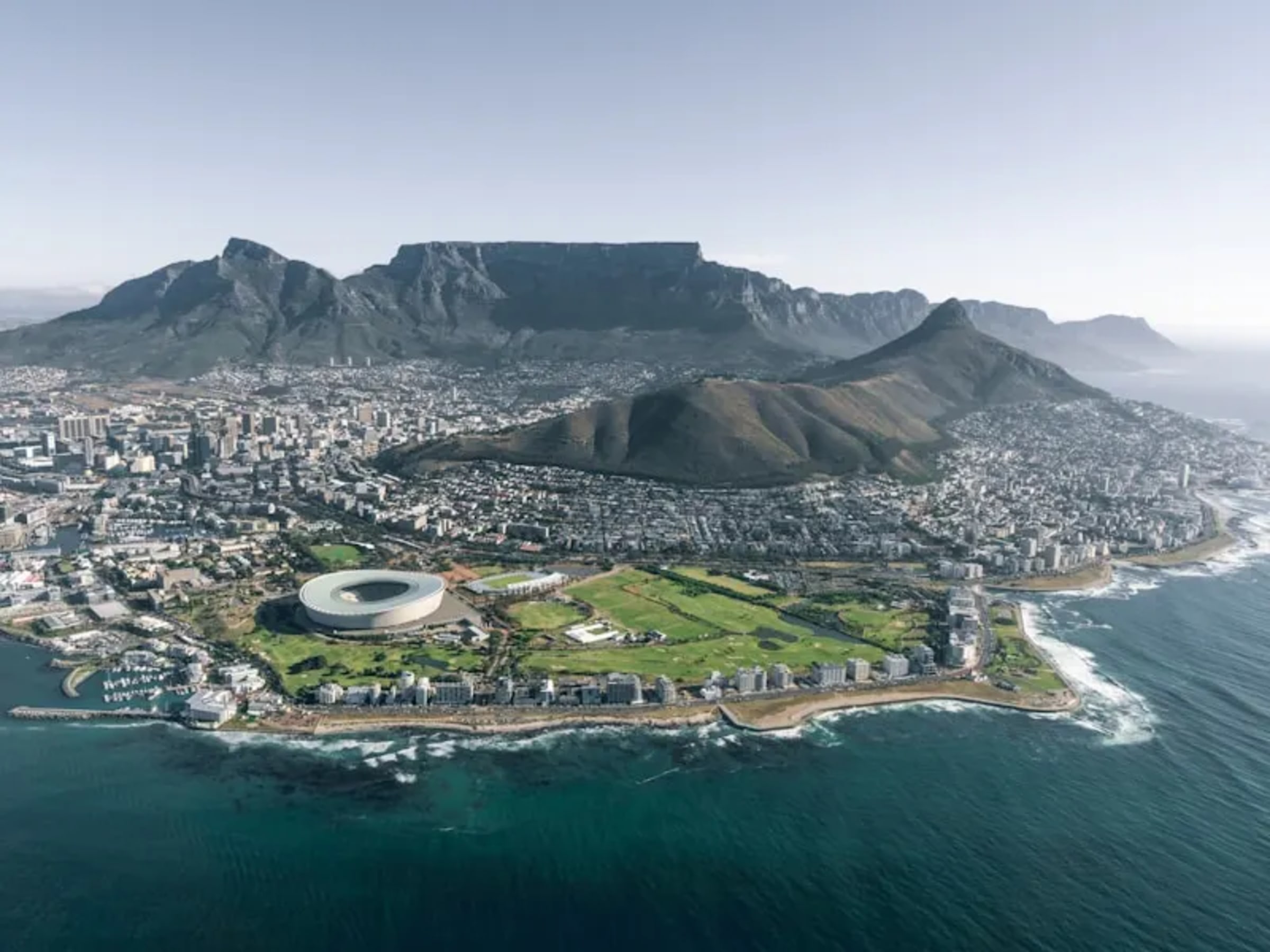
Cape Town is what happens when a flat-topped mountain, two oceans, and 350 years of complicated history converge on a single coastline. The city of 5 million sits at Africa's south-western tip, with Table Mountain (1,086m, UNESCO World Heritage and one of the New 7 Wonders of Nature) rising directly behind the city center and the Atlantic on one side, the warmer False Bay on the other. The photo every visitor leaves with — mountain, ocean, vineyards in the same frame — is the city's everyday reality, not a tourism-board exaggeration.
Table Mountain is the obligatory first move. The cable car ($25 round trip, 5 minutes each way) lifts you 1,086m to a flat plateau covered in fynbos — a unique South African plant kingdom that exists almost nowhere else — with a 360° view of the city, Robben Island in the harbor, and the Atlantic stretching out toward South America. The catch is weather: the famous 'tablecloth' clouds form when southeasterly wind pushes Atlantic moisture up the cliffs, and the cable car closes entirely on windy or cloudy days. Cable car operators don't refund pre-booked tickets when closures happen. The disciplined move is to make the mountain your first morning's plan and reschedule if conditions are wrong. For hikers, Platteklip Gorge (2–3 hours up, free) is the canonical route — steep but straightforward, with a 800m vertical gain.
Robben Island is the trip's emotional weight. Nelson Mandela spent 18 of his 27 prison years here (1964–1982), and the limestone quarry where prisoners broke rocks under intentionally harsh conditions remains exactly as it was. Ferry departs from V&A Waterfront 4x daily; tickets ($30 including ferry + island bus + cell tour) sell out 7–14 days ahead in peak season. The 3.5-hour experience is led by former political prisoners, which transforms what could be a standard prison museum into something more direct. The crossing is rough on windy days — take seasickness tablets if you're sensitive.
The Cape Peninsula day is the third big-ticket item. The 70km southern peninsula drive covers Chapman's Peak Drive (a 9km coastal road carved into a cliff, widely cited among the most scenic roads in the world), Cape Point and the Cape of Good Hope (the dramatic southwestern tip of Africa with a lighthouse and a windswept signpost everyone photographs), and Boulders Beach (an African penguin colony of about 2,500 birds living on a sheltered white-sand cove — boardwalks let you walk within arm's length of penguins lounging in the morning sun). A guided day tour runs $100–130 per person; self-driving is $40–60 in fuel and car rental and lets you control the pace. Watch for baboons — they're aggressive and will open unlocked car doors to steal food.
The Cape Winelands east of Cape Town are the world's most-affordable serious wine region. Stellenbosch (45 min east, 200+ wineries, founded 1679) is the academic anchor — a university town wrapped in vineyards with Cape Dutch architecture. Franschhoek (1h east, the 'French Corner' settled by Huguenot refugees in 1688) is the upscale neighbor, with the Franschhoek Wine Tram ($25) running a hop-on-hop-off route between 8 wineries for the day. Tasting fees run $3–10 per winery — a fraction of Napa or Bordeaux — and the food at La Colombe (Constantia), Babel (Babylonstoren), and Foliage (Franschhoek) ranks among Africa's best.
The food culture is genuinely distinct. Cape Malay cuisine, born from 17th-century Indonesian slaves and political exiles, gave Cape Town the bobotie (mince curry with egg custard, $10–18), bredie (slow-cooked stew, $12–20), and the spiced rice that anchors most local dinners — Bo-Kaap walking tours and cooking classes ($45–80) trace this lineage through the colorful Cape Malay quarter. South African staples include braai (the national outdoor barbecue, $20–35), boerewors (farmer's sausage, $5–10), biltong (cured beef snack, $8–15 per 100g), and the polarizing tamilok-equivalent tripe stew skopkop. Pinotage is the uniquely South African red grape worth seeking — a cross between Pinot Noir and Cinsault developed in 1925, it's divisive globally but pours beautifully in Stellenbosch and Franschhoek.
V&A Waterfront is the canonical safe base — a redeveloped working harbor with 450+ shops, 80+ restaurants, the Two Oceans Aquarium, the Zeitz Museum of Contemporary African Art (MOCAA, opened 2017, housed in a converted 1921 grain silo), and the ferry pier for Robben Island. It's where most international visitors stay (Cape Grace, One&Only Cape Town, Silo Hotel) and the only Cape Town district that's reliably safe to walk after dark.
The safety honesty: Cape Town has serious income inequality and a non-trivial property crime rate, but the tourist core (V&A Waterfront, Camps Bay, Bo-Kaap day visits, the wine regions, Stellenbosch) is genuinely safe with normal urban caution. The two practical rules: don't walk after dark outside V&A — use Uber even 500 meters away (typical fare $3–8) — and don't hike Table Mountain alone, especially on the less-trafficked routes. Smash-and-grab at traffic lights is real; keep phones and bags out of sight in the car. Townships (Langa, Gugulethu, Khayelitsha) are not no-go zones, but go only with reputable guided township tours like Uthando Tours or Coffeebeans Routes — the cultural experience is genuine, but independent visits don't go well.
When to come: November to March is South African summer — 22–28°C, dry, sunny, and the canonical time. December–January is peak local school holiday with hotel rates 50–80% higher and most attractions booking 2–3 months ahead. April–May (autumn) and September–October (spring) are the value sweet spots: 18–25°C, fewer crowds, and Table Mountain cable car running reliably most days. June–August is winter (8–18°C, frequent rain) but it's also Southern Right whale season at Hermanus (1.5h east, June–November peak), the cheapest hotel rates of the year, and the season Capetonians actually enjoy because the tourists are elsewhere.
Bottom line: Cape Town earns its 'world's most-beautiful city' label and is among the best $/value destinations on Earth at the mid and luxury tier — a tasting menu at La Colombe runs $100–150 vs. $400+ for equivalent quality in Paris or Tokyo. Five days handles Cape Peninsula + Stellenbosch comfortably; seven days adds Hermanus whales or Hout Bay. Tack on a 1.5h flight to Kruger or Sabi Sands for a 3–5 day safari and you have the canonical 10-day South African trip.
Things to do in Cape Town
Iconic Landscapes & Hiking
Table Mountain (cable car or Platteklip Gorge)
The flat-topped 1,086m massif that defines the Cape Town skyline — UNESCO World Heritage, one of the New 7 Wonders of Nature, and home to a fynbos plant kingdom found almost nowhere else. The Aerial Cableway lifts you to the summit in 5 minutes with a rotating floor for 360° views. The plateau itself is a 1km flat walking trail with multiple lookout points facing the city, Lion's Head, and Robben Island in the harbor. For hikers, Platteklip Gorge is the canonical route up — 2–3 hours, 800m vertical gain, steep but no scrambling.
Lion's Head sunset hike
The 669m conical peak immediately next to Table Mountain — the canonical Cape Town sunset hike. The trail spirals around the peak in a 90-minute round trip with a final 10-minute scramble that requires using chains bolted into the rock. The summit gives a 360° view of Table Mountain, the Atlantic, Sea Point, and Camps Bay simultaneously. On full-moon nights Capetonians hike up in groups with headlamps for the view of city lights below the moon — a free, locally-loved tradition.
Cape of Good Hope + Cape Point (Cape Peninsula southern tip)
The dramatic southwestern tip of Africa — a windswept national park with a lighthouse, sheer cliffs, and the signpost photographed by every visitor. Cape Point and Cape of Good Hope are two adjacent points within the same Table Mountain National Park reserve. The 65km drive from Cape Town runs through Chapman's Peak Drive (the cliff road) and ends at trails to both viewpoints. Wildlife in the reserve includes ostriches, baboons (aggressive — don't leave food in cars), bonteboks, and Cape mountain zebras.
Boulders Beach (African penguin colony)
A small, sheltered cove in Simon's Town where about 2,500 African penguins have nested since 1982 — established boardwalks let you walk within arm's length of penguins lounging on white sand. The penguins burrow into shaded vegetation behind the beach and waddle down to the water in groups all day. Adjacent Foxy Beach has an active colony you can swim alongside (penguins ignore swimmers) — water is cold but viable in summer. This is one of only three mainland breeding sites for the African penguin globally; numbers have declined 95% since the 1900s, making the visit notable beyond the photos.
History & Culture
Robben Island Ferry & Prison Tour (Nelson Mandela's prison)
Where Nelson Mandela spent 18 of his 27 prison years (1964–1982). The 3.5-hour experience starts with a 30-minute ferry from V&A Waterfront, followed by a bus tour around the island (the limestone quarry, the kramat shrine, the leper colony ruins), and ends with a walking tour of the maximum-security prison led by a former political prisoner. The cell block tour ends at Cell 7 — Mandela's. The former-prisoner-led format is what transforms this from a standard prison museum into something more direct and personal.
Bo-Kaap (Cape Malay quarter walking tour)
The historic Cape Malay neighborhood on Signal Hill's lower slopes — known globally for the rows of brightly-painted houses (the colors date to the post-1834 slave emancipation, when freed residents painted their walls in defiance of mandatory white). The 18th-century Bo-Kaap Museum walks through the Indonesian and Malay slave history, the cooking traditions (bobotie, bredie, koesisters), and the still-active community life. The streets are residential — visit before 10 AM to photograph with good light and avoid disturbing residents.
Zeitz Museum of Contemporary African Art (MOCAA)
Africa's largest contemporary art museum, opened 2017 in a converted 1921 grain silo at V&A Waterfront. The architecture alone is worth the visit — Heatherwick Studio (the firm behind Manhattan's Vessel) hollowed out the concrete silo tubes to create cathedral-like atriums. The collection focuses on African and African-diaspora artists since 2000: Kehinde Wiley, El Anatsui, Nicholas Hlobo, Cyrus Kabiru. The rotating exhibits change every 3–4 months and the Silo Hotel built into the building's upper floors is the canonical Cape Town luxury stay ($1,400–3,500/night).
District Six Museum
The small museum dedicated to District Six, the multiracial inner-city neighborhood demolished by the apartheid government in the 1960s and 1970s. Some 60,000 residents were forcibly removed and the area was bulldozed; most of the land sits empty 50 years later because reconstruction stalled. The museum is built around the personal stories of evicted families — letters, photographs, recovered street signs, a floor map where displaced residents have marked where their houses stood. A small but heavy experience; the canonical apartheid history museum in Cape Town.
Wine, Food & Markets
Stellenbosch Wineries (Boschendal, Spier, Vergelegen, Babylonstoren)
South Africa's anchor wine region — 200+ wineries founded since 1679, with Cape Dutch architecture, vineyards backed by mountains, and tastings at a fraction of Napa or Bordeaux prices. Boschendal (1685, picnics + tastings $8–18), Spier (family-friendly + horseback wine tasting), Babylonstoren (the canonical foodie destination with its garden-to-table restaurant Babel and the on-site Farm Hotel at $600–1,400/night), and Vergelegen (1700 governor's estate with the oldest tree in South Africa) are the marquee picks. Stellenbosch town center is walkable in itself with Cape Dutch buildings dating to the 1690s.
Franschhoek Wine Tram (hop-on-hop-off, 8 wineries)
Franschhoek (the 'French Corner', settled by Huguenot refugees in 1688) is the upscale wine neighbor to Stellenbosch, and the Franschhoek Wine Tram is the canonical way to taste through it without driving. The tram runs on a hop-on-hop-off schedule across 8 lines covering 30+ wineries — you pick a line in the morning and ride it all day, getting off for tastings, lunch, and the next train. Removes the designated driver problem entirely. The town itself is the prettiest in the Winelands with French-themed restaurants, art galleries, and the Huguenot Memorial.
V&A Waterfront Food Market & Constantia food estates
The V&A Food Market (V&A Waterfront, ground floor of the old Power Station) is the canonical casual food experience in Cape Town — 40+ stalls covering Cape Malay curries, biltong, fresh oysters from Knysna, sushi, craft beer, and the South African Trade Tasting Bar serving 24 local wines by the glass. For the high-end alternative, the Constantia wine region (the oldest in South Africa, 1685) has La Colombe (World's 50 Best, $150–300 tasting menu), Beau Constantia, and Buitenverwachting — all 20 minutes from V&A.
Cape Malay cooking class (Bo-Kaap)
Hands-on cooking class at one of three Bo-Kaap operators (Cape Malay Cooking Safari, Bo-Kaap Cooking Tour with Faldela Tolker, Andulela Bo-Kaap class). The class walks through the spice trade origins of Cape Malay food, then teaches you to make bobotie (mince curry with egg custard) or denningvleis (sweet-and-sour lamb), roti, samosas, and sambals. Most classes end with a sit-down meal eating what you've made. A genuine cultural experience that drops the tourist-distance — these are home kitchens or community spaces, not commercial cooking schools.
Beaches, Drives & Day Trips
Camps Bay & Clifton Beaches (Atlantic Seaboard)
The Atlantic Seaboard's marquee beaches — Camps Bay is the wide white-sand strip with the Twelve Apostles mountain range backing it, lined with beach bars, palm trees, and the canonical Cape Town sunset crowd. Clifton (4 small coves separated by granite boulders: 1st, 2nd, 3rd, 4th Beach) is the more sheltered alternative — windier-day refuge with calmer water. Water is genuinely cold (12–18°C / 54–64°F year-round; Atlantic Benguela Current keeps it bracing) but the beaches themselves are world-class. Camps Bay's restaurant strip is the canonical sunset dinner — Codfather, The Bungalow, Caprice.
Chapman's Peak Drive (coastal road)
The 9km coastal road carved into the cliffs between Hout Bay and Noordhoek — widely cited among the world's most scenic coastal drives. 114 curves, sheer drops to the Atlantic, viewpoints every 500 meters. The road is engineered with rockfall netting after fatal accidents in 2000; tolls fund the maintenance. Best as part of the Cape Peninsula day or as a sunset drive on its own. Hout Bay (the fishing harbor at the north end) has Mariner's Wharf for fresh seafood lunch; Noordhoek at the south end has the Farm Village with a popular bakery and craft shops.
Hermanus whale watching (1.5h east, Jun–Nov)
The walking town of Hermanus, 1.5h east of Cape Town on the Whale Coast, is one of the world's best land-based whale-watching destinations. Southern Right whales calve in Walker Bay between June and November (peak Sep–Oct), close enough to the cliff path that binoculars are optional. The town's 'Whale Crier' walks the cliff path with a horn announcing whale sightings — a tradition since 1992. The cliff walk (12km, free) covers the entire bay; boat-based trips ($90–130) get you within 50m of the whales.
Kalk Bay & Muizenberg (False Bay coastal towns)
The False Bay coast (warmer water than the Atlantic side, 16–22°C / 61–72°F summer) hosts two adjacent towns worth a half-day. Kalk Bay is the harbor village with antique shops, Olympia Café (the canonical Cape Town breakfast at $8–15), and the working fishing harbor where fishermen sell catch off the boats at 9–11 AM daily. Muizenberg is the broad beach with the iconic row of brightly-painted Victorian beach huts (the Insta photo) and Cape Town's best beginner surf — the gentle waves are why surf schools (Roxy, Surfshack) base here. Beach surf rental $15–25 per session.
Travel cost
Per person, per day (excludes flights)
Hostel + local food + public transport
$70
Per person / day (excl. flights)
📅 Total cost by trip duration (incl. flights)
3 days
$290
5 days
$420
7 days
$540
Flight estimate: $700–1,500 from Europe (BA/VS/KL direct); $1,200–2,500 from US (via Doha or Dubai) (round-trip estimate)
Monthly weather
Currently in Cape Town: ☀️ 12°C
Cape Town now (Jun)
High 18°C / Low 8°C· Mild
Jan ☀️
High 26°C / Low 16°C
Pleasant
★ Best time to visit
Feb ☀️
High 27°C / Low 16°C
Pleasant
★ Best time to visit
Mar ☀️
High 25°C / Low 14°C
Pleasant
★ Best time to visit
Apr 🌤️
High 23°C / Low 12°C
Pleasant
May 🌤️
High 20°C / Low 9°C
Mild
Jun ⛅
High 18°C / Low 8°C
Mild
Jul ⛅
High 17°C / Low 7°C
Mild
Aug ⛅
High 18°C / Low 8°C
Mild
Sep ⛅
High 19°C / Low 9°C
Mild
Oct 🌤️
High 21°C / Low 11°C
Mild
Nov 🌤️
High 24°C / Low 13°C
Pleasant
★ Best time to visit
Dec ☀️
High 25°C / Low 15°C
Pleasant
★ Best time to visit
Jan
☀️
26°
16°
Pleasant
★Best
Feb
☀️
27°
16°
Pleasant
★Best
Mar
☀️
25°
14°
Pleasant
★Best
Apr
🌤️
23°
12°
Pleasant
May
🌤️
20°
9°
Mild
Jun
⛅
18°
8°
Mild
NOW
Jul
⛅
17°
7°
Mild
Aug
⛅
18°
8°
Mild
Sep
⛅
19°
9°
Mild
Oct
🌤️
21°
11°
Mild
Nov
🌤️
24°
13°
Pleasant
★Best
Dec
☀️
25°
15°
Pleasant
★Best
Practical information
Getting there
Getting around
Money & payments
Language
Cultural tips
Money & payment
Currency
South African Rand (ZAR, R) — R18 ≈ $1.00 (May 2026). USD and EUR cash exchange easily at airports.
Card acceptance
Universal in tourism — Visa, Mastercard, tap-to-pay. Amex acceptance patchier. Cash needed for tips, car guards, township tours.
Tipping
Mandatory in tourism. Restaurants 10–15%, Ubers round up, car guards R5–20, hotel housekeeping R20–50/day, tour guides R100–200/day.
ATM
Use Standard Bank, FNB, Nedbank, or Absa ATMs inside branches or at V&A. Withdrawal fees $3–6. Avoid outdoor ATMs after dark.
Recommended itinerary
Cape Town 3-day route
Day 1 Table Mountain + Robben Island
08:00
Table Mountain cable car (sunrise visit)
1,067m UNESCO mountain; arrive at 8:30 opening to beat afternoon clouds
🎫 15% off — Book lowest price12:00
Lunch at V&A Waterfront
Waterfront restaurants with harbor + mountain views
14:00
Robben Island ferry (Mandela's prison 1964-1982)
Pre-book months ahead; ferry $35 + tour led by former prisoners
🎫 14% off — Book lowest price18:00
Sunset at Signal Hill
Overlooking Cape Town with Lion's Head behind; free
20:00
Dinner at La Colombe (Constantia, World's Top 50)
Fine South African dining ($120-180/person)
Day 2 Cape Peninsula + Penguins
08:30
Cape Peninsula full-day tour
Chapman's Peak Drive + Cape of Good Hope + Cape Point + Boulders Beach penguins
🎫 16% off — Book lowest price11:00
Hout Bay seal island boat trip
30-min boat to Duiker Island seals
13:00
Lunch at Cape Point Restaurant
Within Cape of Good Hope reserve
15:00
Boulders Beach penguins
African penguin colony on white sand beach; $5
19:00
Return to Cape Town + dinner
V&A Waterfront restaurant
Day 3 Stellenbosch Wine Country
09:00
Stellenbosch wine country day tour
3 wine estates + cellar tours + wine pairings
🎫 15% off — Book lowest price13:00
Lunch at Delaire Graff Estate
Iconic wine + cuisine pairing
16:00
Franschhoek wine tram (alternative or addition)
Hop-on-hop-off tram between wineries; $30
20:00
Final dinner at The Test Kitchen alumni restaurant
Cape Town fine dining scene
Where to stay in Cape Town — area-by-area breakdown
Cape Town splits along two coastlines and one harbor. The Atlantic Seaboard (Sea Point, Bantry Bay, Camps Bay, Clifton) is the postcard side — cliff-and-ocean views, sunset beaches, but cold Atlantic water. The False Bay side (Muizenberg, Kalk Bay, Simon's Town) has warmer water but is 30–40 minutes from the city center. V&A Waterfront sits in the middle, a redeveloped harbor that's the canonical safe tourist base. City Bowl and De Waterkant are the inland alternatives. The honest area-by-area below covers which to pick for which type of trip.
The redeveloped working harbor and the canonical safe base — 450+ shops, 80+ restaurants, the Robben Island ferry pier, Zeitz MOCAA, Two Oceans Aquarium, and the Silo Hotel built into the converted grain silo above the museum. Hotels range from mid-range (Victoria & Alfred Hotel, $200–350) to ultra-luxury (One&Only Cape Town at $700–1,500, Cape Grace at $400–800, Silo Hotel at $1,400–3,500). 1-bed Airbnbs run $150–350/night. The only Cape Town district where walking after dark is genuinely safe. Best for: first-time visitors, families, anyone who wants the canonical Cape Town base and is willing to pay the 20–30% premium for safety + walkability. Trade-off: corporate-feeling vs. the more character-laden Sea Point or Bo-Kaap.
The long, safe seaside neighborhood west of V&A — 3km of Atlantic promenade lined with apartments, cafes, restaurants, the Sea Point Pavilion outdoor pool, and the Mouille Point lighthouse. The canonical long-stay base for nomads and the Cape Town locals' preferred walking neighborhood. Hotels run $100–280/night for mid-range (President Hotel, Winchester Mansions); 1-bed Airbnbs $80–200/night. The Promenade is the canonical Cape Town morning run. Best for: long-stayers, second-time Cape Town visitors, anyone who wants neighborhood feel over hotel-resort feel. Trade-off: 8–12 minutes by Uber to V&A; not walking-distance to the canonical sights.
The Atlantic Seaboard's marquee beaches — Camps Bay with the wide white-sand strip backed by the Twelve Apostles mountains, Clifton with four sheltered coves separated by granite boulders. The canonical sunset dinner strip (Codfather, The Bungalow, Caprice) runs along the Camps Bay beachfront. Hotels run $300–800/night for mid-range to luxury (The Bay Hotel, 12 Apostles Hotel, Ellerman House); 1-bed Airbnbs $200–600/night. Best for: honeymooners, beach-focused trips, anyone who wants the photogenic Cape Town base. Trade-off: 12–18 minutes by Uber to V&A; the famous Cape Doctor southeasterly wind can make beach days unpleasant on summer afternoons.
The cliff-perched neighborhood between Sea Point and Clifton — quietest, most exclusive, no commercial strip. The diplomats and execs live here, and the Ellerman House (the 11-room South African villa-hotel at $1,800–3,500/night) is the canonical Cape Town luxury experience. 1-bed Airbnbs at the high end: $250–600/night. Best for: travelers seeking the quietest, most photogenic Atlantic-front base with the smallest crowds. Trade-off: no walking restaurants — you Uber everywhere. The view, however, is the trip's high point if you wake up to it.
The historic Cape Malay quarter immediately above V&A — colorful colonial buildings converted to apartments, restaurants (Origin Coffee, Truth Coffee, Beluga, Anatoli), and design shops. Walkable to V&A in 10 minutes, walkable to Bo-Kaap in 5 minutes. Hotels run $150–350/night (Cape Quarter Hotel, Cape Cadogan); 1-bed Airbnbs $80–250/night. Best for: foodies, design-conscious travelers, returning visitors who want neighborhood feel over harbor view. Trade-off: street parking is hard; the surrounding inner-city blocks become less safe at night, so confirm the after-dark Uber routine.
Cape Town's downtown grid wrapped between Table Mountain and the harbor — Long Street nightlife, Bree Street restaurants (the canonical young foodie strip with Bouchon, Plant, Marrow), the Company's Garden (the 17th-century Dutch East India Company vegetable garden, now a public park), and the Castle of Good Hope (the 1666 colonial fort). Hotels run $100–300/night (Taj Cape Town, Mount Nelson — the iconic pink colonial-era hotel at $500–1,500). 1-bed Airbnbs $60–200/night. Best for: travelers who want the canonical downtown energy + walking access to Bo-Kaap and historic sights. Trade-off: walking after dark is restricted; load shedding is more disruptive here than at the inverter-equipped V&A hotels.
The False Bay coast — warmer water (16–22°C vs. Atlantic's 12–18°C), the iconic row of colorful Victorian beach huts at Muizenberg, the working fishing harbor at Kalk Bay, and the canonical Cape Town breakfast at Olympia Café. Hotels and Airbnbs run $60–200/night — significantly cheaper than the Atlantic side. Best for: surfers (Muizenberg is the city's best beginner break), returning visitors, anyone who wants a quieter alternative to V&A. Trade-off: 30–40 minutes by Uber to the city center, less restaurant density, fewer evening options. The vibe is small-town surf, not city.
The oldest wine region in South Africa (1685) — a leafy southern suburb 20 minutes from V&A with Cape Dutch estates (Groot Constantia, Klein Constantia, Buitenverwachting) and La Colombe, the World's 50 Best restaurant. The neighborhood is residential with a few boutique hotels (Last Word Constantia at $200–500, Cellars-Hohenort at $300–700). Best for: foodies who want La Colombe access without driving, returning visitors looking for the wine-country base without committing to Stellenbosch. Trade-off: 20-min Uber to V&A; the area is quiet enough that you'll feel detached from the city's energy.
The wine-country anchor town with Cape Dutch architecture, 200+ wineries within a 30-minute drive, a university energy, and significantly lower prices than Cape Town. 1-bed Airbnbs $40–100/night; mid-range hotels $80–250/night (Lanzerac, Majeka House). Best for: travelers building a trip around wine, long-stayers seeking a quieter base. Trade-off: 45-min drive to Cape Town; you commit to the wine-country experience rather than splitting time. The honest call is to base Cape Town first for the city sights and spend 2–3 nights in Stellenbosch as a wine-country focus.
Cape Town travel essentials checklist
Cape Town's logistics are well-developed for international travelers — English is universal, Uber is reliable, Western-standard infrastructure mostly works (with the load-shedding caveat). The Cape-specific gotchas are mostly cultural-environmental: the Cape Doctor southeasterly wind that closes Table Mountain, the load-shedding schedules that disrupt work and dinner, the strict adherence to tipping conventions, and the safety routine that constrains your after-dark options. The checklist below covers a 5–7 day trip.
- □ 90-day visa-free entry for US/UK/EU/CA/AU/NZ/JP/KR/SG passports. Return ticket required, 30+ days passport validity from departure, and 2 blank passport pages — South African immigration is strict on the blank-page rule.
- □ Yellow fever certificate required if arriving from yellow-fever-endemic countries (Brazil, Kenya, Uganda, parts of West Africa). Get the vaccine at least 10 days before travel — your home country's health authority maintains the list.
- □ Travel insurance with med-evac coverage is recommended (not legally required) — South African private hospitals are world-class but expensive without coverage. SafetyWing, World Nomads, and Allianz all cover South Africa.
- □ No tourist tax or arrival fee. The departure tax is included in your ticket price.
- □ Print the address of your first night's accommodation — immigration sometimes asks for it on the arrival card.
- □ South African Rand (ZAR) is the working currency — R18 ≈ $1.00 (May 2026). USD or EUR cash exchanges easily at OR Tambo or Cape Town International, with reasonable rates at the airport branches.
- □ ATMs are everywhere in the tourist core (V&A, Sea Point, Camps Bay) — Standard Bank, FNB, Nedbank, and Absa all accept foreign cards. Withdrawal fees run $3–6 per transaction. Use ATMs inside bank branches or in V&A — avoid outdoor ATMs after dark.
- □ Credit cards work universally at hotels, restaurants, supermarkets, and most tourist sights. Visa and Mastercard are preferred; Amex acceptance is patchier. Tap-to-pay is widespread.
- □ Wise and Revolut multi-currency cards beat home-country debit cards on FX by 2–3% — meaningful on a 1–2 week stay.
- □ Tipping is mandatory in Cape Town tourism contexts: restaurants 10–15% (some bills add a 'gratuity' line; check before tipping again), bartender R10–20 per drink, hotel housekeeping R20–50/day, Uber drivers R10–30 round-up, tour guides R100–200/day, car guards (the informal parking attendants) R5–20 per stop, hairdressers 10%.
- □ eSIM via Airalo (10GB 30-day plan ~$25 for South Africa). Activate at the gate before landing at Cape Town International.
- □ Physical Vodacom or MTN SIM at the airport arrival kiosks: R150–300 ($8–17) for 20–60GB. Passport required.
- □ WiFi is reliable in hotels, V&A Waterfront, and most tourist cafes — Cape Town has Africa's best urban WiFi coverage. Workshop17 and Cabal coworking are reliable for video calls.
- □ Load shedding affects WiFi everywhere except inverter-equipped properties. If you have a critical call, schedule it for a guaranteed-power slot via the EskomSePush app (check the day's schedule).
- □ Download offline Google Maps for Cape Town, Cape Peninsula, and Stellenbosch — coverage is fine but data drops in the wine valleys and on the Peninsula's southern stretch.
- □ Layers — Cape Town swings 15°C between morning and evening, even in summer. A warm fleece or light jacket goes in your day bag.
- □ A real waterproof jacket if you're visiting June–August — winter rain is heavy and persistent.
- □ Walking shoes for Table Mountain (Platteklip Gorge is steep and rocky; trail runners or hiking shoes work).
- □ Sunscreen SPF 30+ — the UV at Cape Town's altitude and latitude is intense, especially Nov–Mar.
- □ Sunglasses (not optional — the Atlantic light is bright); hat with a chin strap (the Cape Doctor wind takes hats).
- □ Plug adapter for Type M (15A round-pin) — specific to South Africa, different from UK/EU standards. Bring one; hotels charge $5–10 for spare adapters.
- □ Walk only in V&A and Sea Point Promenade after dark — everywhere else, use Uber even short distances. Typical Uber fare $3–8.
- □ Smash-and-grab at traffic lights is real — keep phones, bags, and laptops out of sight in the car. Don't leave anything visible when parked.
- □ Don't hike Table Mountain or Lion's Head alone — go with a group or guided tour. Muggings on the trails happen occasionally.
- □ Don't visit townships independently — go with reputable operators like Uthando Tours or Coffeebeans Routes who employ residents and contribute to community projects.
- □ Tipping is genuinely expected in South Africa. The 10–15% restaurant tip and the R5–20 car guard tip aren't optional in the way they are in some countries.
- □ Load shedding (rolling blackouts) hits 2.5–4.5 hours per day on a published schedule. Install the EskomSePush app on arrival — it's the canonical tracker that tells you exactly when your area is off.
Where to stay
Click each district to compare hotel deals
City Bowl + V&A Waterfront
Most central. V&A Waterfront has restaurants + shopping + Robben Island ferry.
See hotels in this area
Bo-Kaap
Iconic colored Malay Quarter houses on Cape Town hillside. Photogenic.
See hotels in this area
Camps Bay
Beach district under 12 Apostles mountains. Beach + restaurants.
See hotels in this area
Sea Point + Green Point
Coastal residential with Sea Point Promenade. Less touristy.
See hotels in this area
Constantia + Stellenbosch
Wine countries 30-45 min from city. Day trip or stay.
See hotels in this area
Hout Bay + Llandudno
Atlantic coastal villages south of city. Hout Bay seal island.
See hotels in this area
Cape Town hotel price comparison
Compare Booking.com, Expedia, Hotels.com prices in one place
* Centered on City Bowl + V&A Waterfront — the most hotel-dense area in Cape Town
Top tours & activities in Cape Town
Top-rated by travelers
Frequently asked questions
Most common questions from travelers to Cape Town
Q How much per day in Cape Town?
Budget $70/day (hostel dorm + braai joints + MyCiTi bus + Uber occasionally), mid-range $170/day (3-star hotel V&A + restaurants + Table Mountain + winery day + Uber), luxury $480/day (One&Only or Cape Grace + La Colombe tasting menus + private wine tour + spa). Cape Town is half European prices for similar quality — a tasting menu at La Colombe runs $150–250 vs $400+ in Paris or Tokyo.
Q How many days do I need in Cape Town?
Five nights minimum. Day 1: V&A + jet-lag recovery. Day 2: Table Mountain (book first — weather buffer needed). Day 3: Robben Island + Bo-Kaap. Day 4: Cape Peninsula (Chapman's Peak + Cape Point + Boulders Beach). Day 5: Stellenbosch or Franschhoek wine country. Seven nights adds Hermanus (whales June–November) or a wine-country overnight. Ten nights opens the Kruger safari extension (1.5h flight). Less than 5 nights forces choosing between canonical sights.
Q Best time to visit Cape Town?
November to March is South African summer (22–28°C, dry, sunny, canonical). December–January is peak with hotel rates 50–80% higher. April–May and September–October are the value sweet spots (18–25°C, fewer crowds, Table Mountain running reliably). June–August is winter (8–18°C, rain) but cheap hotels and whale season at Hermanus. The Cape Doctor southeasterly wind closes Table Mountain on windy days — make the cable car visit Day 2 for weather buffer.
Q Visa for Cape Town?
Visa-free 90 days for US/UK/EU/Canada/Australia/New Zealand/Japan/Korea/Singapore passports. Return ticket required, 30+ days passport validity, 2 blank passport pages (strict). No tourist tax. Yellow fever certificate required if arriving from yellow-fever-endemic countries.
Q Is Cape Town safe?
Tourist core (V&A, Camps Bay, Sea Point, Bo-Kaap day, Stellenbosch) is safe day-and-evening. Don't walk after dark outside V&A or Sea Point Promenade — use Uber ($3–8 typical fare). Don't hike Table Mountain alone. Smash-and-grab at traffic lights is real — keep valuables hidden in cars. Townships only with reputable guided tours (Uthando, Coffeebeans Routes). Generally workable for solo female travelers with normal urban caution.
Q English level in Cape Town?
Universal — English is one of 11 official languages and spoken by everyone in tourism. All hotels, restaurants, attractions, signage, and menus are in English. Afrikaans greetings (Howzit, Lekker) are appreciated but unnecessary.
Q Famous food + restaurants?
Cape Malay cuisine is the canonical local food — bobotie ($10–18), bredie ($12–20), koesisters. Braai (BBQ, $20–35), boerewors (sausage, $5–10), biltong (cured meat, $8–15). South African wines: Pinotage (unique), Chenin Blanc, Cabernet from Stellenbosch. Top restaurants: La Colombe (World's 50 Best, $150–250), FYN (Asian-South African fusion, $100–200), Pot Luck Club (Woodstock, $80–150). Casual: V&A Food Market, Eastern Food Bazaar, Truth Coffee (top-rated steampunk roastery).
Q Cape Winelands — how to visit Stellenbosch + Franschhoek?
Stellenbosch (45 min east, 200+ wineries) is the academic anchor; Franschhoek (1h east, the French Corner) is the upscale neighbor with the Wine Tram hop-on-hop-off ($25). Day options: 1) Wine Tram in Franschhoek (8 wineries, no driving), 2) Private driver day from Cape Town ($100–200), 3) Self-drive with designated driver. Top wineries: Boschendal (1685, picnics), Spier (family-friendly), Babylonstoren (Cape Dutch + Farm Hotel $600–1,400/night), Vergelegen (governor's estate). Tastings $3–10. Best to overnight 1–2 nights in Stellenbosch or Franschhoek for the full experience.
Q Can I add a safari to Cape Town?
Yes, via 1.5h flight to Kruger or Sabi Sands. Kruger National Park (camp lodges $200–800/night), Sabi Sands (private reserve, best leopard sightings, $800–2,500/night), Madikwe (malaria-free, $600–1,500/night). Local Aquila Game Reserve (2h drive, $130 day tour) is the time-limited option but limited-Big-5. Best safari time June–October. Book 4–6 months ahead for peak season via SafariBookings.com or Yellow Zebra.
Q Table Mountain — cable car or hike?
Cable car ($25 round trip, 5 min) is the easy option — book the first cable car at 8:30 AM for clearest skies, or the last car up for sunset. Cable car closes entirely on windy or cloudy days; no refunds on weather closures. Platteklip Gorge hike (2–3h ascent, 800m vertical gain) is the canonical free alternative — steep but no scrambling. Don't hike alone — go with a group or guided tour. Make Table Mountain Day 2 of your trip for weather buffer days.
Q How does load shedding affect tourists?
Load shedding (rolling blackouts, 2.5–4.5h per day during high-strain periods) affects WiFi, lighting, and restaurants. Most hotels and coworking spaces have inverters or solar backup — verify when booking. Install the EskomSePush app on arrival to track the day's schedule for your specific area. Restaurants typically run on generator power and don't lose service. The Sept–Mar period historically has less load shedding than the winter months.
Q Hotels + airport + getting around?
Cape Town International (CPT) is 20km from city. MyCiTi bus to V&A $5 (R90), 30 min; Uber $15–25, 25 min. Avoid public taxis. Stay at V&A Waterfront for safety + walking access ($200–700 — One&Only, Cape Grace, Silo Hotel), Sea Point for long-stay neighborhood feel ($80–300), Camps Bay for beach + sunset ($300–800 — The Bay Hotel, 12 Apostles), or Constantia for wine-country base ($200–700 — Last Word Constantia, Cellars-Hohenort). Avoid downtown CBD after dark. Uber + MyCiTi bus combo covers most needs; rent car only for Cape Peninsula and wine country days.

TripPick
Data-driven travel guide
Weather and exchange rates on this page are fetched live from external APIs; cost and itinerary data are verified periodically against local sources.
Weather
Open-Meteo API
Exchange
ECB rates
Costs
Local price data
Itineraries
Traveler reviews
Book your Cape Town trip
Compare flights, hotels, and tours all in one place
Prices via Skyscanner, Booking.com, GetYourGuide
Go deeper into Cape Town
Click each topic for the dedicated guide
Similar to Cape Town
Same region, similar climate and budget