Japan 🌤️ 21°C · Now
Japan's most cosmopolitan port city — Kobe beef + 1,300-year Arima Onsen + Mt. Rokko top-3 night view
Japan 🌤️ 21°C · Now
Japan's most cosmopolitan port city — Kobe beef + 1,300-year Arima Onsen + Mt. Rokko top-3 night view Kobe
Japan

Kobe at a glance
As of 2026, Kobe travel is best in Mar, Apr, May, Oct, Nov, from about $85/day (budget, ex-flights), with a 3-day itinerary. Top sight: Mouriya Honten (1885 — Kobe's oldest steakhouse).
$85+
Budget tier · excl. flights
From major hubs
Kansai International (KIX, 60 km southeast on Osaka Bay) is the regional hub — no Kobe-specific airport for international flights (Kobe Airport UKB handles domestic only). From KIX: JR Kansai Airport Line + Special Rapid to Sannomiya 70 min ¥1,800; or Kobe-Kansai Bay Shuttle ferry 30 min ¥1,880 + Port Liner 18 min ¥340 (total 60 min); or limousine bus 65 min ¥2,000.
Visa-free 90 days
For most Western passports
$1 ≈ ¥159
JPY · indicative rate
Mar, Apr, May, Oct, Nov
Currently Jun
Humid subtropical with four seasons (Mar-May spring 13-23°C ideal · Jun-Sep humid summer 26-32°C with tsuyu rainy season Jun-Jul · Oct-Nov autumn 16-22°C ideal · Dec-Feb cool dry winter 2-11°C with rare snow at sea level)
Now 🌤️ 21°C
01:24
JST (UTC+9)
Japanese
English signage at major stations + Kitano + Nankinmachi tourist sites; Kobe has the highest English fluency in Kansai after Osaka thanks to 150+ years of international port history
Why visit Kobe?
Kobe is Japan's most cosmopolitan port city and the country's sixth-largest by population (1.5 million). It sits 25 minutes west of Osaka and 55 minutes from Kyoto by JR Special Rapid — and that central Kansai position is both its strength and a strategic question for travelers: Kobe works extremely well as a 2-3 night Kansai-loop stop, but most travelers integrate Kobe into a broader Osaka-Kyoto-Nara-Himeji itinerary rather than basing exclusively in Kobe. The city earns its slot because of its 1868 treaty-port history: Kobe was one of the five Japanese ports that opened to international trade after 200+ years of national isolation, and it became the country's first city where Japan systematically encountered Western architecture, Western haircuts, Western beer, the world's first Sino-Japanese Chinatown (Nankinmachi 1868), Japan's oldest mosque (1935), and Western-influenced food (the city's bakeries Donq 1905 and Freundlieb 1924 still operate continuously in their original locations). That heritage layer is the reason to come — and the modern Kobe beef + Mt. Rokko night view + Arima Onsen combination is the contemporary counterpart that completes the picture.
The Kitano Ijinkan-gai foreign-residence hillside is the canonical Kobe heritage experience. 20+ preserved Western-style ijinkan houses built by European and American merchants who settled in Kobe after 1868 climb the slope 15 minutes north of Sannomiya. The canonical houses: Kazamidori (Weathervane House, 1909, $5 entry, the Kobe city landmark with the rooster weathervane), Moegi-no-Yakata (1903, $4, the green-shuttered former US consul's residence), Eikoku-kan (English House, $4), and Yamate Hachiban-kan (former French consulate, $5). The Kitano Tourist Information Center at the main intersection has free walking maps in English. The Kobe Muslim Mosque (1935 — Japan's oldest, free to view exterior, founded by Tatar Turkish refugees who fled the Russian Revolution via Manchuria) anchors the religious-diversity layer that defines Kobe. Combined Kitano walking + Sannomiya covered shotengai dinner is the canonical first-day pattern.
Kobe beef is the strict-naming-protected wagyu that defines the city's food identity. The protected designation requires Tajima cattle bloodline + Hyogo Prefecture rearing + minimum A4 grade with BMS 6+ marbling, certified through the Kobe Beef Marketing & Distribution Promotion Association. Roughly 5,000 head qualify annually (vs 30,000+ for general Tajima beef), making genuine Kobe beef a strict naming-protected product. The canonical preparations: teppanyaki at Mouriya Honten 1885 (Kobe's oldest steakhouse, four generations of family ownership, $90-160 dinner / $50-90 lunch — the standard set includes appetizer + grilled vegetables + 100-150g A5 sirloin or fillet + garlic rice + miso + dessert), Wakkoqu Kitano (modern teppanyaki with English-speaking chefs, $80-130 dinner / $45-75 lunch), or Steakland Kobe (the budget-friendly A3-A4 grade option, $55-80 dinner / $35-50 lunch). Reservations 1-2 weeks ahead for Sunday-Tuesday dinner; weekday lunch is easier walk-in. Lunch sets are 40-50% cheaper than equivalent dinner with similar quality — the smart-money order.
Mt. Rokko (931m) and Arima Onsen are Kobe's two go-to evening + side-trip destinations. Mt. Rokko's summit observation is officially designated as one of Japan's top 3 night views (along with Hakodate and Nagasaki) — the city + Osaka Bay + Akashi Kaikyo Bridge spread below at 931m elevation. Access: Kobe Subway Seishin-Yamate Line to Shin-Kobe (3 min, $2) + Rokko Cable Car (10 min ride, $14 round trip) + Rokko Bus from Cable Car summit to Garden Terrace (10 min, included). Best 10:00-12:00 for daylight panoramic views or evening 18:00-22:00 for the canonical Japan-top-3 night view. Mt. Rokko summit runs roughly 10°C cooler than the city — pack a layer year-round. From Mt. Rokko summit, the Rokko-Arima Cable Car (12 min ride, $10 each way) descends to Arima Onsen on the north side — one of Japan's three oldest hot-spring towns, first mentioned in chronicles around 631 AD with continuous hot-spring operation for ~1,300 years. The stepped narrow alleys + traditional inns + onsen-egg sellers make Arima Japan's most accessible traditional onsen town. Two famous waters: kinsen (golden iron-rich) and ginsen (silver radium-containing). Goshoboh (founded 1191, certified by Guinness World Records as the world's oldest ryokan still in continuous operation, $600-1,500/night overnight or $80-120 kaiseki lunch + onsen day-pass) is the canonical Arima experience.
Nada district sake is Kobe's third signature. The Nada-Gogo (Five Villages of Nada) along the eastern coast between Sannomiya and Ashiya produces roughly 25% of all Japanese sake output, with 8 historic breweries open for English-friendly tasting tours: Hakutsuru Sake Brewery Museum (1862 founded, free entry + $5 tasting flight + $4 souvenir cup, the most polished tourist experience), Kiku-Masamune Sake Brewery Museum (1659 founded — the oldest in Nada, free entry + $4 tasting), Sawanotsuru Museum (1717 founded, free entry + $4 tasting), and Kobe Shushinkan/Fukuju (modern brewery + restaurant + sake-pairing dinner, $30-50). All are 5-10 minutes from Hanshin Sumiyoshi or Uozaki stations (15 min from Sannomiya). The recommended pattern: visit 2 breweries in one afternoon (free entry + paid tasting flights $4-8 each), with a Fukuju restaurant dinner for the proper sake-pairing meal.
Honest trade-offs worth knowing. First, Kobe beef pricing is genuinely high — A5 grade teppanyaki dinner runs $80-200 per person, roughly 30% more than equivalent Tokyo wagyu of the same grade because of the strict Tajima-cattle naming protection. Lunch sets ($40-80) at the same restaurants are 90% of the experience at half the price. Second, Kobe is geographically central in Kansai but most travelers base in Osaka or Kyoto for larger hotel inventory and nightlife — Kobe as a 1-2 day Kansai stop or as a Sannomiya base for day-trips both work. Third, the Mt. Rokko cable car + ropeway ($14 round trip) is required for the night-view experience — there's no road alternative to the top viewing decks, and weekend evenings sell out cable-car slots. Fourth, Arima Onsen ryokan weekend pricing surges 50-100% during autumn foliage peak (mid-to-late November) and winter snowy-onsen weekends (January-February). Fifth, the 1995 Great Hanshin-Awaji Earthquake (magnitude 6.9, 6,434 deaths) remains a defining local memory — the Disaster Reduction and Human Renovation Institution near HAT Kobe is a thoughtful museum on this history, and avoiding flippant earthquake jokes is basic respect. The Kobe Luminarie LED installation each December commemorates the earthquake victims and is the city's signature winter event.
Getting here. From KIX (60 km southeast): JR Kansai Airport Line + Special Rapid via Osaka Station to Sannomiya 70 min ¥1,800 (the canonical option, JR Pass-eligible). From Osaka: JR Special Rapid Osaka Station to Sannomiya 25 min ¥420; Hankyu Express from Umeda 30 min ¥330 (cheaper). From Kyoto: JR Special Rapid via Osaka 55 min ¥1,100. International direct hubs to KIX: NYC 13h45 (ANA, JAL), LA 11h30 (ANA), London 13h via stopover (BA), Sydney 9h30 (Qantas, JAL), Seoul 2h (KAL, Asiana, Peach), Bangkok 5h30 (Thai, ANA), Singapore 6h45 (SQ, ANA), Hong Kong 3h45 (Cathay, ANA). Inside Kobe: JR Tokaido + Sanyo lines, Hankyu, Hanshin, Kobe Subway Seishin-Yamate + Kaigan Line, and Port Liner all converge at Sannomiya. ICOCA or Suica IC card (from KIX or any Kansai station, $5 refundable deposit) works on everything. Walking covers Minato Mirai-equivalent Harborland end-to-end in 20 minutes; Sannomiya to Kitano to Chinatown all within 15-min walking radius. The City Loop Bus and Port Loop Bus ($2 ride, $7 day pass) connect all major harbor attractions on a 60-min sightseeing loop.
Bottom line: Kobe is the best Kansai add-on for travelers who want Japan's most cosmopolitan port-city heritage (Kitano foreign-residence walking), the country's strictest-protected wagyu (Kobe beef teppanyaki), a top-3 designated night view (Mt. Rokko), and the world's oldest ryokan (Goshoboh at Arima Onsen). Two nights make sense if Himeji Castle is also on the list (40 min west by JR Special Rapid; Japan's most-preserved 17th-century castle and UNESCO World Heritage Site). Three nights only if Arima Onsen overnight is planned. For first-time Kansai visitors, the canonical play is Osaka or Kyoto as base + Kobe as a 1-day or overnight Kansai-loop stop. For travelers wanting deep Kobe (Kobe beef + Mt. Rokko + Arima + Nada sake + Kitano), Kobe Sannomiya as base + Osaka + Kyoto day-trips equally works.
Things to do in Kobe
Kobe Beef & Sannomiya
Mouriya Honten (1885 — Kobe's oldest steakhouse)
Founded 1885 by Mouri Shintaro, four generations of family ownership across 141 years. The canonical Kobe beef pilgrimage destination with multiple Sannomiya branches (Honten / Yamate / 3-chome / Vienna). Chef-counter teppanyaki with English-speaking staff and explicit Tajima-bloodline A5 grade certificate displayed table-side. The kitchen carries paperwork tracing each cut to a specific Hyogo farm — the documentation is part of the experience. The standard order: A5 Kobe beef teppanyaki set with appetizer + grilled vegetables + 100-150g A5 sirloin or fillet + garlic rice + miso soup + dessert. Lunch sets are 40-50% cheaper than equivalent dinner with similar quality.
Wakkoqu Kitano (modern teppanyaki + English-speaking chefs)
Modern teppanyaki opened 2002, the smart traveler-friendly alternative to Mouriya. Kitano main branch on the foreign-residence hillside walking distance to Kitano Ijinkan-gai. Open kitchen with English-speaking chefs explaining each cut, the certification, and the cooking sequence. Smaller and more intimate than Mouriya (10 counter seats + 4 private rooms vs Mouriya's 50+ seats). The smart pick for solo travelers or couples wanting an interactive teppanyaki experience.
Sannomiya Center-gai Covered Shotengai (600m + 200+ shops)
Kobe's main covered shopping street — a 600-meter shotengai stretching west from JR Sannomiya West Exit, lined with 200+ shops and 40+ restaurants. The covered roof makes this all-weather walkable and the heart of central Kobe local life. Restaurants range from $5 standing-counter ramen to $20-30 mid-range sit-down sushi and izakaya. The canonical 'local Kobe dinner' option for travelers wanting affordable family-friendly meals beyond the Kobe beef teppanyaki scene.
Kitano Ijinkan-gai (Foreign-residence district)
Kazamidori (Weathervane House, 1909 — Kobe city landmark)
Built 1909 by German trader Gottfried Thomas, the canonical photographed Kitano ijinkan with its iconic rooster weathervane on the roof — the visual symbol of Kobe city and a 'Nationally Important Cultural Property.' The red-brick exterior + green-shuttered windows + Western-Japanese hybrid garden are the canonical Kitano photo angle. Interior open as a small museum showing late-Meiji-era foreign-residence life: piano + dining table + Western kitchen + servants' quarters. The hillside above the house has the canonical photo angle looking down toward Sannomiya.
Moegi-no-Yakata (1903 — Green-shuttered House)
Built 1903 by Hunter Sharp, the former US Consul General to Kobe. The green-shuttered American-colonial style exterior + interior period rooms make this the canonical complement to the neighboring Kazamidori. Walking distance 30 seconds north. Interior open as a small museum showing US foreign-residence life: porcelain + brass fittings + period photography. Designated as a 'Nationally Important Cultural Property.'
Kobe Muslim Mosque (1935 — Japan's oldest mosque)
Founded 1935 by Tatar Turkish refugees who fled the Russian Revolution via Manchuria and established the Kobe Muslim community. Japan's oldest mosque still in continuous operation. Survived the 1923 Kanto earthquake aftermath, 1945 US firebombing (the mosque was spared while surrounding buildings burned), and the 1995 Great Hanshin-Awaji Earthquake. The mosque actively serves the Kobe Muslim community (Tatar, Turkish, Pakistani, Bangladeshi, Indonesian, Malaysian residents) + international travelers + students. Friday prayers welcomed visitors with modest dress.
Yamate Hachiban-kan (former French consulate)
Built 1888 as the French Consulate General to Kobe, the canonical European-style ijinkan with French-architectural detailing (Mansard roof, ornate iron balcony, French formal garden). The interior showcases French foreign-residence life with period furniture + tableware + library. One of the higher-slope Kitano ijinkan houses — 10-min walk from Kazamidori + Moegi cluster.
Mt. Rokko & Arima Onsen
Mt. Rokko (931m — Japan's top-3 night view)
The 931m summit observation officially designated as one of Japan's top 3 night views (along with Hakodate and Nagasaki) — the city + Osaka Bay + Akashi Kaikyo Bridge spread below at 931m elevation. Access via Kobe Subway Seishin-Yamate Line to Shin-Kobe + Rokko Cable Car (10 min ride from 320m base to 800m summit, $14 round trip) + Rokko Bus from Cable Car summit to Garden Terrace (10 min, included). The summit area has 4 restaurants + cafes (Rokko Garden Terrace), the Rokko Music Box Museum ($14, Japan's oldest music box collection), the Forest Botanical Garden ($5), and 360° observation. The summit runs roughly 10°C cooler than the city — pack a layer year-round.
Arima Onsen (1,300-year hot-spring town)
One of Japan's three oldest hot-spring towns — first mentioned in chronicles around 631 AD, with continuous hot-spring operation for ~1,300 years. Located 30 minutes north of Sannomiya via Kobe Electric Railway (Tanigami transfer) or the scenic Rokko-Arima Cable Car descent. The stepped narrow alleys + traditional inns + onsen-egg sellers make this Japan's most accessible traditional onsen town. The town's two famous waters — kinsen (golden iron-rich) and ginsen (silver radium-containing) — give Arima its 'water of immortality' reputation. 50+ ryokan options at every price point from $250-1,500/night including dinner + breakfast.
Goshoboh (1191 — World's Oldest Ryokan, Guinness-certified)
Founded 1191, certified by Guinness World Records as the world's oldest hotel/ryokan still in continuous operation. Located in the heart of Arima Onsen. Multi-generation Kanemori family ownership across 833 years. The kaiseki dinner (9 courses, $200-300 even as a non-staying meal) features Tajima beef + Akashi seafood + Hyogo seasonal ingredients prepared in the historic kitchen. The kinsen (iron-rich golden) and ginsen (silver) onsen baths are the canonical Arima experience. The world's oldest ryokan claim is genuine and the experience is the headline Arima trip.
Nankinmachi & Heritage
Nankinmachi Chinatown (Japan's second-oldest after Yokohama)
0.1 km² of densely packed restaurants and shops bounded by three color-painted Chinese gates — Choanmon (east), Sai-anmon (west), Nankinmachi-mon (south). Founded 1868 by Cantonese traders attached to Western firms that opened in Kobe under the new treaty system. The neighborhood now has 200+ restaurants by Kobe Chinatown Development Association count — smaller and less deep than Yokohama Chinatown's 600+ but the heritage layer is genuine. Roushouki (1915 — Nankinmachi's oldest restaurant) and Min-Min (1953 — the standing-counter pork bun institution) are the canonical institutions. Open 11:00-21:00 typical; Chinatown empties by 22:00 weeknights.
Hotel Okura Kobe (Meriken Park bay-view luxury)
5-star, 475 rooms across two 35-story towers on Meriken Park with full Kobe Bay panorama + Akashi Kaikyo Bridge view at night. 5 restaurants including Yamazato kaiseki + Italian + Brazilian-Japanese fusion. The canonical Kobe honeymoon and anniversary pick — pair with the Yamazato 35F restaurant for the full skyline-view dining experience.
Freundlieb (1924 German bakery in 1929 church)
Founded 1924 by Heinrich Freundlieb, a German baker who arrived in Kobe in 1922 with the post-WWI European emigrants. The bakery has continuously served the original 1924 recipes for 102 years. The current location is the magnificent 1929 Union Church building on the Kitano lower slope, converted to bakery + cafe in 1997 after the 1995 earthquake damaged the original Motomachi shop. The arched stained-glass windows + wooden ceiling beams + brass fittings make this Japan's most architecturally distinctive bakery space.
Day Trips & Add-ons
Himeji Castle (1609 — UNESCO World Heritage, the White Heron Castle)
Japan's most-preserved 17th-century castle and one of only 12 original Edo-period castle keeps remaining in Japan. Completed 1609 under the Ikeda clan; survived the 1868 Meiji restoration's castle demolitions, the 1923 Kanto earthquake, and World War II air raids without significant damage. UNESCO World Heritage Site (1993, the first Japanese cultural property designated). Nicknamed Shirasagi-jo ('White Heron Castle') for its white plaster exterior. The complex includes the main keep (Daitenshu, 5-story 46m tall, climbable to the top floor), three subsidiary keeps, 83 surviving buildings, and the encircling stone walls + moats. 40 min west of Sannomiya by JR Special Rapid ($7 each way, JR Pass-eligible).
Osaka (25 min east — Namba, Dotonbori, Osaka Castle)
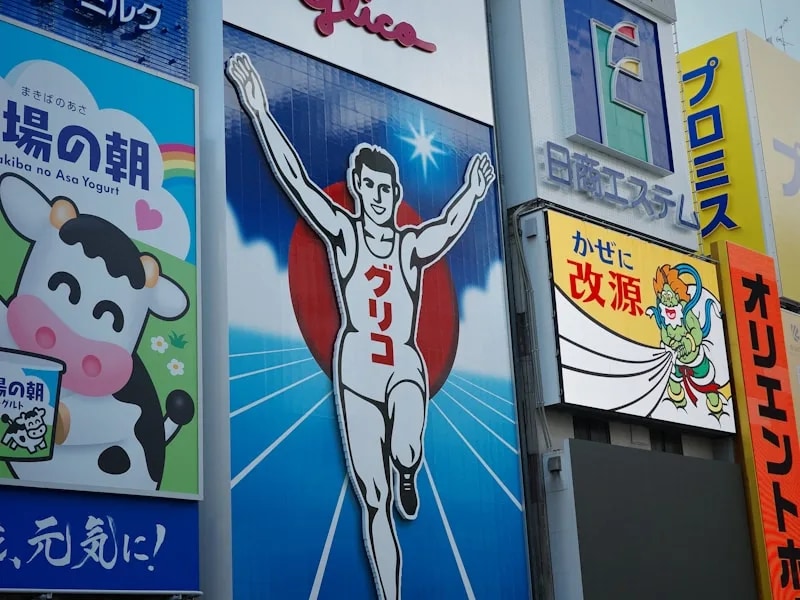
Japan's third-largest city (population 2.7 million), 25 minutes east of Sannomiya by JR Special Rapid (¥420). Day plan from Kobe: Namba shopping + Dotonbori glowing-signs district (Glico Man billboard since 1935 + Don Quijote Dotonbori) + Hozen-ji Temple + Kuromon Market + Shinsaibashi shopping + Osaka Castle (Toyotomi Hideyoshi's 1583 flagship, current 1931 reconstruction $6 entry) + Umeda Sky Building 45F observation ($14). Lunch options: takoyaki at Aizuya Honten 1933 + kushikatsu at Daruma 1929 + Osaka-style okonomiyaki at Mizuno 1945 — all 100-year-class institutions.
Kyoto (55 min east — Fushimi Inari, Kiyomizu-dera, Gion)
Japan's cultural and former imperial capital (population 1.5 million), 55 minutes east of Sannomiya by JR Special Rapid via Osaka transfer (¥1,100). Day plan from Kobe: Fushimi Inari Shrine (free, the famous 10,000 vermilion torii gates climbing Mt. Inari) + Kiyomizu-dera Temple ($4, the 1633 wooden veranda jutting from the cliffside, UNESCO World Heritage) + Gion geisha district walking (free, the canonical photogenic pedestrian street with maiko + geiko sightings 17:00-19:00) + Yasaka Shrine. Add Arashiyama bamboo forest if time (40 min west of Kyoto Station by JR or bus).
Travel cost
Per person, per day (excludes flights)
Hostel + local food + public transport
$85
≈ ¥13,515 JPY
Per person / day (excl. flights)
📅 Total cost by trip duration (incl. flights)
3 days
$410
≈ ¥65,190
5 days
$670
≈ ¥106,530
7 days
$920
≈ ¥146,280
Flight estimate: $700-1,500 from major Asian hubs to Kansai International (KIX) via direct flights; $1,000-2,500 from US/EU/Australia direct to KIX; then $3-15 train KIX → Sannomiya (or $15 ferry+monorail combination) (round-trip estimate)
Monthly weather
Currently in Kobe: 🌤️ 21°C
Kobe now (Jun)
High 26°C / Low 19°C· Pleasant
Jan 🍂
High 9°C / Low 2°C
Cool
Feb 🌥️
High 10°C / Low 2°C
Cool
Mar 🌥️
High 13°C / Low 5°C
Cool
★ Best time to visit
Apr ⛅
High 19°C / Low 10°C
Mild
★ Best time to visit
May 🌤️
High 23°C / Low 15°C
Pleasant
★ Best time to visit
Jun ☀️
High 26°C / Low 19°C
Pleasant
Jul 🔥
High 30°C / Low 23°C
Hot
Aug 🔥
High 32°C / Low 25°C
Very Hot
Sep ☀️
High 28°C / Low 22°C
Hot
Oct 🌤️
High 22°C / Low 15°C
Pleasant
★ Best time to visit
Nov ⛅
High 16°C / Low 9°C
Mild
★ Best time to visit
Dec 🌥️
High 11°C / Low 4°C
Cool
Jan
🍂
9°
2°
Cool
Feb
🌥️
10°
2°
Cool
Mar
🌥️
13°
5°
Cool
★Best
Apr
⛅
19°
10°
Mild
★Best
May
🌤️
23°
15°
Pleasant
★Best
Jun
☀️
26°
19°
Pleasant
NOW
Jul
🔥
30°
23°
Hot
Aug
🔥
32°
25°
Very Hot
Sep
☀️
28°
22°
Hot
Oct
🌤️
22°
15°
Pleasant
★Best
Nov
⛅
16°
9°
Mild
★Best
Dec
🌥️
11°
4°
Cool
Practical information
Getting there
Getting around
Money & payments
Language
Cultural tips
Money & payment
Currency
Japan uses Japanese Yen (JPY). 1 USD ≈ 148 JPY (April 2026). Cash is still common at small restaurants, standing-counter shops, and traditional markets; cards (Visa, Mastercard, JCB) work at all major hotels, chain restaurants, department stores, and increasingly convenience stores. Bring USD cash from home and use 7-Eleven ATMs (Seven Bank) or Japan Post ATMs (Yucho) — both accept foreign cards with $0 Japanese-side withdrawal fees ($0-3 from your home bank). Standing-counter Nankinmachi shops, smaller Nada sake brewery cellar tastings, and Arima Onsen ryokan supplementals are cash-only; bring ¥500-1,000 coins and small bills.
Card acceptance
Visa, Mastercard, JCB are widely accepted at major hotels (Hotel Okura Kobe, Oriental Hotel, ANA Crowne Plaza, Kobe Kitano Hotel), Sannomiya department stores (Daimaru Kobe, Sogo Kobe-Hankyu, Yodobashi Sannomiya), Harborland Mosaic + Umie shopping complex, Kobe beef teppanyaki restaurants (Mouriya, Wakkoqu, Steakland), and chain restaurants. AmEx is accepted at most hotels and high-end restaurants but less consistently at smaller establishments. ICOCA/Suica IC card works at most chain convenience stores, vending machines, and many restaurants — load $20-50 to your IC card at any station for the simplest cashless option. Standing-counter Motomachi shops, smaller Nada sake brewery cellar tastings, and some Arima Onsen ryokan supplementals are cash-only.
Tipping
Not customary in Japan and sometimes considered rude. Restaurant prices include service, even at Kobe beef teppanyaki dinners ($200 per person). Hotel tipping is not expected. Tour guides may accept small gratuities on private tours but never expect them. The proper Japanese equivalent is a polite thank-you bow ('Arigato gozaimashita').
ATM
7-Eleven (Seven Bank) ATMs and Japan Post (Yucho) ATMs accept foreign cards with no Japanese-side fees and standard exchange rates. Both are found everywhere in Kobe — 7-Eleven on every other block in Sannomiya and Motomachi, Japan Post inside every Japan Post office. Withdraw $200-300 per transaction. Some bank ATMs (Mitsubishi UFJ, Sumitomo Mitsui, Mizuho) do not accept foreign cards — use 7-Eleven or Japan Post only. Tax-Free shopping at major retailers refunds 10% consumption tax on departure-day-only purchases ¥5,000+ ($34+) per shop per day; bring passport.
Recommended itinerary
Kobe 3-day route
Day 1 Sannomiya + Kitano Ijinkan-gai + Nankinmachi + Harborland + Kobe beef
13:00
KIX → Sannomiya via JR Kansai Airport Line + Special Rapid (70 min)
JR Special Rapid via Osaka Station to JR Sannomiya 70 min ¥1,800; or Kobe-Kansai Bay Shuttle ferry 30 min + Port Liner 18 min for ~$15 total 60 min
15:00
Hotel check-in (Sannomiya / Kitano / Harborland)
ANA Crowne Plaza Kobe $200-310, Hotel Monterey Kobe $130-190, or Kobe Kitano Hotel boutique $260-420
16:00
Kitano Ijinkan-gai foreign-residence walking
Kazamidori (Weathervane House 1909) + Moegi-no-Yakata 1903 + Eikoku-kan + Kobe Muslim Mosque 1935 (Japan's oldest). $15-25 for 3-4 house entries, free to walk the streets
🎫 12% off — Book lowest price18:30
Nankinmachi Chinatown + Harborland Mosaic sunset
Min-Min 1953 pork buns $3-5 + Kobe Port Tower 108m 2024-reopened observation $7 + Mosaic-pier sunset over Kobe Bay (canonical Kobe photo)
20:00
Mouriya Honten Kobe beef teppanyaki dinner (1885)
Kobe's oldest steakhouse, 4 generations of family ownership. A5 Kobe beef teppanyaki set $90-160 dinner; lunch sets $50-90
Day 2 Mt. Rokko cable car + Arima Onsen + Nada sake breweries
08:30
Kobe Subway to Shin-Kobe + Rokko Cable Car
Cable car 10 min ride from 320m base to 800m summit, $14 round trip. Mt. Rokko Garden Terrace at 931m with 4 restaurants + cafes + 360° observation
🎫 17% off — Book lowest price10:00
Mt. Rokko summit (931m) — Japan's top-3 night view
Officially designated as one of Japan's top 3 night-view destinations (with Hakodate, Nagasaki). Rokko Music Box Museum $14 + Forest Botanical Garden $5
13:00
Rokko-Arima Cable Car descent → Arima Onsen lunch + onsen
12-min ride $10 each way. Goshoboh 1191 (world's oldest ryokan per Guinness) day-pass kaiseki lunch + onsen $80-120, or public onsen Kin-no-Yu $5 + casual lunch $15-25
🎫 17% off — Book lowest price16:30
Return Sannomiya + Hakutsuru Sake Brewery Museum (1862)
Hanshin Line from Sannomiya to Sumiyoshi 10 min $2. Hakutsuru Museum free entry + $5 tasting flight + souvenir cup. The most polished Nada brewery tour
19:00
Sannomiya Center-gai covered shotengai dinner
Kobe iekei ramen $10-15, modern izakaya $25-40, Sannomiya Center-gai sit-down sushi $20-35
Day 3 Himeji Castle UNESCO World Heritage day-trip
08:00
JR Special Rapid to Himeji (40 min, ¥970)
Direct one-seat ride from Sannomiya, no transfers; JR Pass covers it; trains every 15-30 min
09:30
Himeji Castle (1609 — UNESCO World Heritage, the White Heron Castle)
Japan's most-preserved 17th-century castle, one of only 12 original Edo-period castle keeps. Main keep 5-story 46m climbable; $13 / ¥1,000 entry
🎫 14% off — Book lowest price12:30
Koko-en Garden + Anago-meshi lunch
1992 adjacent landscape garden $5 / combo with castle $16. Anago-meshi (steamed sea eel over rice) at Ikkyu-an $22 set or Himeji oden standing-counter $8-15
15:30
JR return Sannomiya + final shopping + farewell dinner
Daimaru Kobe + Sogo Kobe-Hankyu basement food court for edible souvenirs (Kobe beef gift packs $30-80, wagashi $15-30, sake $15-50)
20:00
KIX departure via JR Kansai Airport Line
Sannomiya → KIX 70 min ¥1,800. Refund ICOCA/Suica $5 deposit at JR ticket office
Where to stay
Click each district to compare hotel deals
Sannomiya
Central transit hub where JR, Hankyu, Hanshin, Kobe Subway, Port Liner all converge. Daimaru Kobe + Sogo Kobe-Hankyu + Sannomiya Center-gai covered shotengai 600m. The canonical first-visit base — walking to Kitano, Motomachi, Chinatown, Meriken Park, Harborland all within 15-20 min.
See hotels in this area
Kitano (Ijinkan-gai)
1860s foreign-residence hillside — 20+ preserved Western-style ijinkan houses (Kazamidori 1909, Moegi-no-Yakata 1903, Eikoku-kan) + Kobe Muslim Mosque 1935 (Japan's oldest) + Kobe Kitano Hotel boutique. Hilly walking; less hotel inventory but the heritage atmosphere is genuine.
See hotels in this area
Motomachi & Nankinmachi
Motomachi shopping street (heritage European bakeries Freundlieb 1924 + Donq 1905 + Honmoku Tei 1880 yoshoku) + Nankinmachi Chinatown (Japan's second-oldest, 200+ restaurants in 0.1 km² with Roushouki 1915 + Min-Min 1953).
See hotels in this area
Harborland & Meriken Park
Modern waterfront with Kobe Port Tower 108m (2024 reopened), Maritime Museum, Mosaic shopping mall + Umie complex, Hotel Okura Kobe 35F bay-view luxury, and the 1995 Earthquake Memorial Stone preserved at the partially-collapsed harbor wharf.
See hotels in this area
Nada district
Eastern coast brewery zone — 8 historic sake breweries (Hakutsuru 1862, Kiku-Masamune 1659, Sawanotsuru 1717, Fukuju/Kobe Shushinkan) producing 25% of all Japanese sake. 15 min from Sannomiya by Hanshin Line to Sumiyoshi or Uozaki.
See hotels in this area
Arima Onsen
1,300-year-old onsen town 30 min north by Kobe Electric Railway via Tanigami transfer, or scenic Rokko-Arima Cable Car descent from Mt. Rokko summit. Goshoboh 1191 (world's oldest ryokan per Guinness) + 50+ ryokan options. Kinsen (golden) + ginsen (silver) onsen baths.
See hotels in this area
Kobe hotel price comparison
Compare Booking.com, Expedia, Hotels.com prices in one place
* Centered on Sannomiya — the most hotel-dense area in Kobe
Top tours & activities in Kobe
Top-rated by travelers
Frequently asked questions
Most common questions from travelers to Kobe
Q How much does a day in Kobe cost?
Budget $85/day (3-star Sannomiya business hotel + Min-Min Chinatown standing-counter meals + 1 attraction + IC card travel); mid-range $200/day (4-star Sannomiya or Kitano boutique hotel + Kobe beef teppanyaki lunch set $40-60 + Rokko-Arima cable car loop + Nada sake brewery tasting); luxury $510+/day (Hotel Okura Kobe or Oriental Hotel + Mouriya Honten A5 dinner $130-160 + private Arima Onsen ryokan + Rokko-san dinner at the night-view restaurant). As a day-trip from Osaka or Kyoto (no Kobe hotel): $50-100 total — $8-12 round-trip train + $40-80 Kobe beef teppanyaki lunch + $10-20 attractions (Kobe Port Tower $7 + Kitano walking free). Kobe beef is the realistic budget pressure point — the premium ($80-200 for A5 grade teppanyaki dinner) is roughly 30% more than equivalent Tokyo wagyu of the same grade because of the strict Tajima-cattle naming protection. Kobe is roughly equivalent in price to Osaka and 10-15% cheaper than Kyoto on hotels.
Q How many days do I need in Kobe?
Two days is the sweet spot for first-time visitors — Day 1 covers Sannomiya + Kitano Ijinkan-gai foreign-residence walking + Harborland sunset + a Kobe beef teppanyaki dinner; Day 2 adds the Rokko-Arima cable car loop with Mt. Rokko night view and an Arima Onsen afternoon. Three days makes sense if Himeji Castle day trip (40 min by JR, $9 each way) is on the list — Japan's most-preserved 17th-century castle and UNESCO World Heritage is genuinely worth the half-day. One day works as an Osaka or Kyoto side trip (25 min by JR from Osaka, $4) but you'll have to choose between Kitano-Harborland-beef or Rokko-Arima. Most travelers integrate Kobe into a broader Kansai loop (Osaka + Kyoto + Kobe + Nara + Himeji over 5-7 days) rather than basing in Kobe — Osaka's Namba or Kyoto's Gion has more hotel inventory and nightlife.
Q When is the best time to visit Kobe?
Late March to early May (spring) and late October to early December (autumn) are the prime windows. Cherry blossoms peak the first week of April along the Ikuta River and at Suma Beach Park; the Sorakuen Garden's weeping cherry is the canonical Kobe sakura spot. Autumn momiji peaks mid-to-late November at Arima Onsen and Mt. Rokko's Forest Garden (Rokko-san is roughly 10°C cooler than the city below, so foliage opens 2 weeks earlier). The Kobe Luminarie (early-to-mid December, free) is the city's signature winter event — 200,000+ LED lights commemorating the 1995 earthquake along a 600-meter Sannomiya promenade. Summer (June-August) is hot and humid (28-33°C / 82-91°F), but Mt. Rokko's evening cable car gives a 10°C cooler refuge for the city-light viewing. Winter (December-February) is cool and dry (3-12°C / 37-54°F) with rare snow — Arima Onsen in winter is the canonical Japanese onsen retreat.
Q Do I need a visa to visit Kobe?
No additional visa beyond Japan's standard tourist visa (Kobe is part of Japan). US, UK, EU, Canadian, Australian, New Zealand, Japanese, and Korean passport holders get visa-free entry for 90 days for tourism. Passport must have 6+ months validity. Visit Japan Web (vjw-lp.digital.go.jp) is the recommended pre-arrival registration — fill out customs and immigration declarations online before flying, generate QR codes, and skip the paper forms at KIX arrival. The Visit Japan Web QR is technically optional but saves 10-15 minutes at airport queues.
Q Is Kobe safe for tourists?
Extremely safe — Japan ranks among the world's safest countries for travelers, and Kobe's reputation as Japan's most cosmopolitan port city (open to foreign trade since 1868) has fostered a particularly welcoming attitude toward international visitors. Violent crime targeting tourists is essentially nonexistent. Petty theft is rare; lost wallets and phones are routinely returned at police boxes (koban). Solo female travelers consistently report Kobe as comfortable day or night. The only sensitivity worth noting: the 1995 Great Hanshin-Awaji Earthquake (magnitude 6.9, 6,434 deaths) remains a defining event in local memory — the Disaster Reduction and Human Renovation Institution near HAT Kobe is a thoughtful museum on this history, and avoiding flippant earthquake jokes is basic respect. Emergency: 110 (police), 119 (ambulance / fire). English-speaking emergency response is available via the Japan Helpline (0570-000-911).
Q Does English work in Kobe?
Yes for tourism. Kobe has the highest English fluency in Kansai after Osaka — a legacy of its 150+ years as Japan's most internationally exposed port city, with foreign-residence districts in Kitano dating to the 1868 treaty-port era. English signage is excellent at JR Sannomiya Station, Hankyu Sannomiya, all Kitano Ijinkan-gai houses, Harborland, Kobe Port Tower, Mt. Rokko cable car stations, and Arima Onsen tourist offices. Conversational English is widely understood at hotels, Kobe beef teppanyaki restaurants, Kitano cafes, and major tourist sites. Smaller standing-counter shops in Motomachi or Nada district sake breweries may require Google Translate's Japanese pack (download offline before flying). The Kobe Tourist Information Center inside JR Sannomiya Station East Exit (09:00-19:00 daily) has multilingual English / Chinese / Korean staff and free maps.
Q What food is Kobe famous for?
Three signatures define Kobe food. (1) Kobe beef (神戸ビーフ) — the strictly defined wagyu protected designation (Tajima cattle bloodline + Hyogo Prefecture-raised + minimum A4 grade with BMS 6+ marbling) eaten as teppanyaki ($80-200 dinner / $40-80 lunch set), sukiyaki ($60-150), or shabu-shabu ($60-150) at canonical specialists like Mouriya 1885 (Kobe's oldest steakhouse), Wakkoqu, Steakland. (2) Nada district sake — Kobe's eastern Nada-Gogo (Five Villages of Nada) area produces roughly 25% of all Japanese sake output, with 8 historic breweries open for cellar tours and tasting (Hakutsuru 1862, Kiku-Masamune 1659, Sawanotsuru 1717, Fukuju/Kobe Shushinkan). (3) Kobe yoshoku (Western-Japanese fusion) and bakery heritage — Freundlieb 1924 + Donq 1905 + Honmoku Tei 1880 + Cafe La Mille 1972 anchor the multi-generation institutions. Add Nankinmachi Chinatown (Japan's second-oldest after Yokohama) for sit-down Cantonese and standing-counter dim sum.
Q How do I get from Kansai Airport (KIX) to Kobe?
Three canonical routes. (1) JR Kansai Airport Line + Special Rapid via Osaka Station to JR Sannomiya 70 min ¥1,800 (the standard option, JR Pass-eligible). (2) Kobe-Kansai Bay Shuttle ferry from KIX terminal directly to Kobe Airport Island 30 min ¥1,880 + Port Liner monorail to Sannomiya 18 min ¥340 (the fastest option, total 60 min for ~$15). (3) Limousine bus from KIX to Sannomiya 65 min ¥2,000 (luggage-friendly, no transfers). Taxi from KIX to Kobe $130-180 (not recommended). After 22:00 last trains from Sannomiya for KIX are around 21:30; for the ferry, last sailing 22:30; limousine bus runs until 23:00.
Q Kobe vs Osaka vs Kyoto — which should I prioritize?
All three are essential Kansai stops; the choice depends on trip length. For first-time Japan Kansai visitors with 5-7 days, the canonical loop is Osaka 2 nights + Kobe 2 nights + Kyoto 2-3 nights + Nara + Himeji day-trips. Osaka is the megacity default with the largest hotel inventory + Dotonbori neon + soul-food (takoyaki, okonomiyaki, kushikatsu). Kyoto is the cultural anchor with temples + Gion geisha district + Fushimi Inari + Arashiyama. Kobe is the port-city heritage stop with Kobe beef + Kitano Ijinkan-gai + Mt. Rokko night view + Arima Onsen. For travelers with only 3-4 days in Kansai, prioritize Osaka + Kyoto + 1-day Kobe excursion. For travelers specifically wanting Kobe beef + Arima Onsen experience, base in Kobe Sannomiya for 2-3 nights with Osaka/Kyoto day-trips. The 25-min JR Special Rapid between Osaka and Kobe makes day-tripping in either direction equally easy.
Q What's the deal with Kobe Chinatown (Nankinmachi) vs other Chinatowns?
Kobe's Nankinmachi is Japan's second-oldest Chinatown after Yokohama — 200+ restaurants in a 0.1 km² grid, founded 1868 by Cantonese traders attached to Western firms that opened in Kobe under the new treaty system. Smaller and less deep than Yokohama Chinatown's 600+ restaurants but the heritage layer is genuine — Roushouki (1915 founded, Nankinmachi's oldest restaurant, Cantonese + dim sum) and Min-Min (1953 founded, the standing-counter pork bun institution) are multi-generation institutions. By depth and value, Kobe's Nankinmachi does not match Hong Kong, Singapore Chinatown, or Yokohama's Chinatown — prices are 30-50% higher than Tokyo Chinese restaurants and dramatically higher than the same dishes in Hong Kong. The genuine reason to come is the convenience: 10-min walk from Sannomiya, perfect for a quick standing-counter pork bun lunch or sit-down Cantonese dinner during a Kobe beef-and-Kitano day. For tourists who can't go to Hong Kong on this trip, Yokohama Chinatown (Asia's largest) is a stronger substitute than Kobe Nankinmachi.

TripPick
Data-driven travel guide
Weather and exchange rates on this page are fetched live from external APIs; cost and itinerary data are verified periodically against local sources.
Weather
Open-Meteo API
Exchange
ECB rates
Costs
Local price data
Itineraries
Traveler reviews
Book your Kobe trip
Compare flights, hotels, and tours all in one place
Prices via Skyscanner, Booking.com, GetYourGuide
Go deeper into Kobe
Click each topic for the dedicated guide
Similar to Kobe
Same region, similar climate and budget